
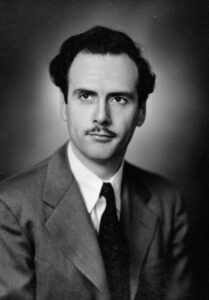
Josephine Smith, Public domain, via Wikimedia Commons.
Marshall McLuhan, who died December 31, 1980, was not a historian of technology, but historians of technology are in his debt for some of the most penetrating insights into our problems that have ever appeared. Starting his postsecondary education as an engineering student at the University of Manitoba, McLuhan shifted to English, eventually receiving a Ph.D. in that subject from Cambridge.
Inspired by the two iconoclasts-James Joyce in English literature and Harold Innis in economic history-he put forward the point of view (one of his favorite descriptive terms for his “method”) that the medium itself is more influential than the content transmitted. Thus the effect of a printed message is to force the sender and recipient to linear thought. No message is a complete transference of all the sense data that impinge on the sender, and the recipient fills in the gaps in his own mind. Hence the recipient of a written message will fill in more gaps because of the nature of this “hot” medium than he will if the “same” message is transmitted by the “cool” medium of television. And as the effect depends on the sum of the data input and the mental addition one makes, the medium of communication forces the mode of reception and “the medium is the message.”
However, media have changed historically with our communications technology from the preliterature primacy of voice communication through the primacy of the printed word (with the technology of writing spurred to mass use by the technology of printing) to the modern resurrection of vocal and pictorial presentation in radio and television. This resurrection of preliterate communication-now with the added factor of virtually instantaneous electric transmission-was considered by McLuhan to bring our environment back to that of a tribal society in a “global village.”
These “points of view” were expressed in The Mechanical Bride, the prize-winning Gutenberg Galaxy, the influential On Understanding Media, and other works.
McLuhan’s work has been the despair of those who sought to find a traditional logical-development package. He was capable of writing what he called “mandarin prose” but chose an analogical form rather than a logical one (Technology and Culture 17, no. 2, 263). The fact that he chose an iconoclastic mode may have rendered him less accessible to the traditional scholar than to the pop culture of a tribal TV generation. Those exposed to his thought in a dialogue mode such as that of his famous seminars given at the Centre for Technology and Culture at the University of Toronto, of which he was founder and director-found, in the verbal interplay which arose while they combated statements outrageous at first thought, a clearer guide to his nonparadigmatic probes.
Few emerged from his dialogues unchanged in their perspectives, and the serious readers of his works were similarly affected. By introducing the idea that our perspectives have been altered throughout history by the introduction of new communication technologies, McLuhan has left us with an expanded view of the history of technology and has opened doors for many to enter.
John W. Abrams
Previously published as John W. Abrams, “Herbert Marshall McLuhan (1911–1980),” Technology and Culture 22, no. 4 (1981): 843–4,
https://dx.doi.org/10.1353/tech.1981.a890973.
McLuhan, Marshall. “Misunderstanding the Media’s Laws.” Technology and Culture 17, no. 2 (1976): 263–63. https://muse.jhu.edu/article/891717.
McLuhan, Marshall. “McLuhan’s Laws of the Media.” Technology and Culture 16, no. 1 (1975): 74–78. https://muse.jhu.edu/article/891500.
McLuhan, Marshall, and Barrington Nevitt. “The Argument: Causality in The Electric World.” Technology and Culture 14, no. 1 (1973): 1–18. https://muse.jhu.edu/article/893349.
McLuhan, Marshall. The Medium Is the Message: An Inventory of Effects. Random House, 1967.
McLuhan, Marshall. On Understanding Media. Toronto: University of Toronto Press, 1964.
McLuhan, Marshall. The Gutenberg Galaxy: The Making of Typographic Man. Toronto: University of Toronto Press, 1962.
McLuhan, Marshall. The Mechanical Bride: Folklore of Industrial Man. London: Duckworth Overlook, 2011. Originally published 1951.