
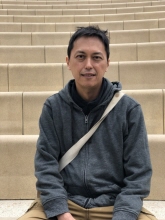
 We mourn the death of Aaron Stephen Moore (1972–2019), forerunner in the history of technology in Asia, friend, colleague, and scholar. His life and career cut short has left an empty space in the heart of a network of scholars who have known and benefited from his quiet curiosity that he deftly exercised to encourage historical inquiry and excellence. By co-writing this memorial, we bear witness to Aaron and the profound impact he had as a bridge connecting scholars in North America, Asia, and Europe.
Aaron was a gifted multilingual historian with unusual intellect nurtured since birth in Japan, all to pursue innovative and engaging studies of twentieth-century Asia. As the only son of Stephen William Moore and Lisa Chung Park Moore, Aaron grew up in a stimulating, international environment. Born in Yokosuka, Japan, he lived in Vienna during the 1980s. By the time he graduated from the American School in Japan, he had engaged with at least four languages (English, Japanese, Korean, and German), proficient in each to a high degree. Aaron earned his undergraduate degree in 1994 from the University of Virginia and then lived in rural Kyoto Prefecture, Japan, as an English teacher. The Tokyo University of Foreign Studies, where he conducted research toward his dissertation, was his “intellectual home” in the country. After earning his doctorate from the History Department in 2006 at Cornell University, where he met his life partner, Nilanjana Bhattacharjya, Aaron held positions at Massachusetts Institute of Technology, Ohio University, University of California, Los Angeles, and, finally, became a beloved faculty member at Arizona State University.
For the joint SHOT / HSS / 4S meeting in 2011, we received a panel time in the early morning: Friday at 8:30 am. With his teaching and administrative responsibilities, Aaron planned to fly east and arrive before the session, only to be delayed somewhere in the Southeast. He emailed Hiromi [Mizuno] and I the previous evening, and we brainstormed to work on a solution. Quickly setting up a Skype connection, we managed to connect to Aaron, who worked from his laptop in the airport lounge. He presented his paper with control over the screen at the venue, and just as he finished, his plane was called to the gate. He turned the Q&A over to those physically present in Cleveland, and this brought laughter from the audience, as it appeared to be a planned gesture. —John DiMoia
Aaron’s scholarship was marked by an intellectual curiosity that was only trumped by his quiet acts of enormous commitment to nurture the field through various initiatives that brought people together across international and disciplinary boundaries. He had taken these initiatives since the earliest moments in his career as a Terasaki Research Fellow at UCLA, where he successfully helped convene a workshop in May 2009. Its theme—”Dis/Continuities: Nation-State Formation in Japan with Science, Technology, and Medicine, 1932–62″—ran through Aaron’s public presentations thereafter. He stressed important pre- and postwar continuities in the personnel who managed Japan’s international economic and civil engineering projects.
Aaron is probably best known for his groundbreaking work, Constructing East Asia (Stanford University Press, 2013), which earned high accolades nationally and internationally for shedding light on the intellectual history of technological thought that permeated Japan and colonial Manchuria and Korea. By exploring the concept of the “technological imaginary,” he innovatively highlighted the fusion of technological and intellectual elements that supported Japan’s wartime enterprise across time and space. Technology, as Aaron argued, was not just an objective, rational force but something constituting a subjective, human, even utopian realm that played out at theoretical levels and in specific civil engineering projects abroad. The Japanese translation of his book (Jimbun Shoin, 2019) was anticipated as an intellectual wakeup call for the postwar generations in Japan who have forgotten the contentious relationship between the former colonial empire and its people, let alone historical tensions between the West and Asia.
As a tireless researcher, Aaron had a great talent for locating the subtleties of imperial ethos embodied in internal reports housed at Japanese company archives. Such a refined sensitivity, along with his creativity and collegiality, formed the basis of a multinationally collaborative work (coedited by John DiMoia and Hiromi Mizuno) with nine scholars from Asia and North America, Engineering Asia: Technology, Colonial Development, and Cold War Order (Bloomsbury, 2018). Aaron’s chapter, “From ‘Constructing’ to ‘Developing’ Asia: Japanese Engineers and the Formation of the Post-Colonial, Cold War Discourse of Development in Asia,” embodies the spirit, direction, and sophistication of this international scholarship. The book as a whole answers intriguing questions that Aaron and many in the field (should) have had: how colonial development transfigured into the so-called international development aid of the Cold War period.
Aaron’s colleagues at Arizona State [University] miss him dearly. Research and teaching were his first loves, but beyond many contributions in these domains, Aaron played an important role in departmental affairs over the last several years. He was a tireless advocate for global history and Asian studies, helping improve curricula and encouraging us to hire faculty with non-Western interests. —Christopher Jones
Aaron’s critical attention to developmental technology as well as its social, environmental, and postcolonial consequences is demonstrated in his work on Japanese reparations, international aid projects, and dam construction on the Yalu River, which led to his second book project, Damming Asia. The ambition of this project was widely anticipated within and outside of academe when he won a major grant from the National Endowment for the Humanities. Upon hearing this news, Arizona’s then-House of Representatives congresswoman, Kyrsten Sinema, wrote him a letter, offering support in any way that she or her office could provide for his endeavor. The new book was to see through the career of Japan’s leading development engineer, Kubota Yutaka—the protagonist in Constructing East Asia—up to 1989, as Kubota’s consultant company, Nippon Koei, built multipurpose dams throughout Asia. Aaron’s critical discussion of Kubota, “the shogun of the Mekong River,” would have served as an invaluable, timely contribution to our intertwined understandings of the techno-economic development of postwar Asia and Japan’s postwar economic growth. By highlighting the regional dynamics and exchanges within Asia that shaped the Cold War, the book was poised to challenge Western-focused Cold War narratives and to broaden the scope of Japan studies.
Aaron tirelessly advocated for global history with keen sensitivity to local cultures. His avid interests in sports (such as cricket and soccer), music (from punk rock to classical music), food (from everywhere), and his dedication to friends and family (especially in Japan, India, Korea, SriLanka, and the United States) reflected his enthusiasms for life and how he cared about others. In the course of his research, he sought ways to give back to the communities that supported his research in Vietnam, Korea, and Japan by taking time and energy to present his research to local audiences in their home languages.
In the fall of 2016 Aaron introduced me to Nobuhiro Yamane, Misato Shimizu, and Kan Li, and we went about assembling [our panel]. . . . Rereading the organizational emails from Aaron, I was deeply amazed at how Aaron inspired all of us to articulate our ideas with great clarity. He also devoted time and energy to nurture early-career scholars like myself. —Ying Jia Tan
The novelty of his focus on (East) Asian civil engineering—seeing it as a historical site to better understand how humans, technology, and environment interacted with one another—was only one of many reasons that graduate students and scholars around the world sought his advice and mentorship. For many former and current graduate students, Aaron opened up new intellectual horizons and skillfully connected them to scholars working in adjacent fields.
Two weeks before his passing, Aaron attended his last academic conference at the Fifteenth International Conference on the History of Science in East Asia, held in Korea. In addition to presenting his research, Aaron chaired an early-career panel on the history of engineering in Asia during the Cold War. It was exhilarating to watch him work in his wheelhouse of engineering history. As usual, he exceeded the typical chairing duties by beseeching the audience to mentor the graduate student presenters. There, as he had modeled throughout his career, Aaron amply demonstrated his quiet intensity, serious and ebullient energy, wit, and meditative insights.
We will remember Aaron S. Moore by pursuing the areas of scholarship and teaching that he championed with the same level of care, justice, and responsibility he would have maintained. Let us find a way to mend that empty space and keep the humaneness of Aaron’s processes from going into the wind.
Takashi Nishiyama, Lisa Onaga, Philip Brown, John DiMoia, Yulia Frumer, Christopher Jones, Hiromi Mizuno, Ying Jia Tan, Togo Tsukuhara, and Nobuhiro Yamane
Originally published as Takashi Nishiyama et al., “In Memoriam: Aaron S. Moore (1972–2019),” Technology and Culture 61, no. 2 (2020): 678–81, https://dx.doi.org/10.1353/tech.2020.0058.
Mizuno, Hiromi, Aaron Stephen Moore, and John Paul DiMoia. Engineering Asia: Technology, Colonial Development and the Cold War Order. London: Bloomsbury Academic, 2020.
Onaga, Lisa, and Aaron S. Moore. “Introduction: Searching for the Historical Roots of 11 March 2011.” Technology and Culture 58, no. 1 (2017): 154–58. https://dx.doi.org/10.1353/tech.2017.0005.
Moore, Aaron Stephen. “Japanese Development Consultancies and Postcolonial Power in Southeast Asia: The Case of Burma’s Balu Chaung Hydropower Project.” East Asian Science, Technology and Society: an International Journal 8, no. 3 (2014): 297–322. https://muse.jhu.edu/article/553198.
Moore, Aaron Stephen. “Para-existential Forces of Invention: Nakai Masakazu’s Theory of Technology and Critique of Capitalism.” positions: east asia cultures critique 17, no. 1 (2009): 127–57. https://muse.jhu.edu/article/267326.