
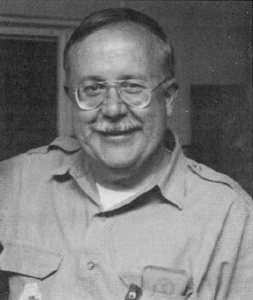
 It is difficult to go anywhere in the National Museum of American History without seeing some imprint of Edward Ezell, who served for twelve years as supervisory curator of the Division of Armed Forces History. From the back rooms that housed his massive collections in military history to the exhibit halls that reflected his fresh new look at the lives of ordinary soldiers, the Smithsonian museum has been vastly altered by Ed’s strong presence. Perhaps even more important was the way Ed lifted the spirits of everyone who worked with him. His limitless energy, his enthusiasm for history, and his dedication to public service were an inspiration.
For me personally, it was especially painful that Ed did not see the opening of “Science in American Life,” just four months away when he died. Over the years that I labored with colleagues on this exhibit, I looked to Ed for administrative, intellectual, and moral support. Even as his cancer progressed, his support and wise counsel continued unabated. It seemed impossible that he would not be there when the job was done, and, at the opening, I was sure I heard a familiar bass voice offering congratulations.
Ed Ezell was born and grew up in Indianapolis, Indiana. His mother came from a well-to-do family who once owned hotels in that city but lost their property and money in the Depression. His father, originally from Kentucky, was an inspector for the Agriculture Department. As Ed told it, his father met his mother when she was working as a switchboard operator in one of the hotels formerly owned by her family. A world-renowned expert in firearms, Ed began to learn about his subject as a boy who, like many Midwesterners, grew up around guns and was fascinated by the way they worked. Although never a hunter, Ed liked to go shooting in the Indiana countryside. The passion for shooting and experimenting with guns of all kinds stayed with him throughout his life.
At Butler University in Indianapolis, Ed began to shape an adolescent hobby into a future career, studying military history and graduating with honors in 1961. The emergence of the field of the history of technology just at that time allowed him to develop his interests in new directions, particularly in the area of technical processes, while indulging his lifelong love of tinkering with mechanisms. In 1961, Ed entered the Hagley program at the University of Delaware and two years later received his master’s degree in American industrial history with a master’s thesis on Civil War cannon. In 1969, he earned a doctorate in the history of technology from Case Institute of Technology, studying with Melvin Kranzberg, Carroll Pursell, and Edwin Layton, among others. His dissertation on the evolution of the M-16 rifle became the basis for his 1984 book, The Great Rifle Controversy: Search for the Ultimate Infantry Rifle from World War II to Vietnam and Beyond. This study carried into the mid-20th century one of the enduring themes in the history of technology—the critical role played by arms industries in the evolution of the nation’s manufacturing practices. Placing the history of firearms in the broader context of the history of technology was one of Ed’s major contributions to his field of study.
From 1966 to 1972, Ed taught the history of science and technology at North Carolina State University, Raleigh, and at Sangamon State University in Springfield, Illinois. In 1968, he married Holly Everding, who died in 1971. Soon after her death, Ed left teaching and spent two years in Singapore, working for the gun collector Sam Cummings as head of Interarms’ Southeast Asia branch. Ed roamed the region in search of antique guns, successfully mining the legacies of imperialism and unearthing many British weapons of late-19thcentury vintage. Although only a brief interlude in his career, Ed’s Singapore experience during the last years of the Vietnam war left a lasting impression. It sparked his academic interests in the history of small arms, sensitizing him especially to the military and political questions that soon became one of his research specialties. Ed also drew practical lessons from his sojourn. He maintained that long hours spent in offices of minor officials awaiting their permissions honed diplomatic skills that served him well later in his collecting career.
When he returned to the United States, his career took another turn. While continuing to freelance as a writer on defense policy, he signed on in 1974 as contract historian with the National Aeronautics and Space Administration (NASA) at the Lyndon Johnson Space Center in Houston, Texas. From 1980 to 1982, he served as project historian of the Space Center. His years with NASA resulted in two major books, written with Linda Neuman Ezell, whom he had married in 1973: The Partnership: A History of the Apollo Soyuz Test Project (1978) and On Mars: A History of NASA’s Explorations of the Red Planet (1984). Specialists regard these as among the best works written under the auspices of the NASA history programs. A departure from his primary academic interests, these writings displayed Ed’s versatility, especially his talents for institutional history and for using international comparison as an analytical tool. Never a narrow specialist, Ed had a wide command of political and diplomatic history and a prodigious memory for facts far beyond the world of guns.
In 1982, he came to the Museum of American History. Under his stewardship, the Smithsonian military history collections entered the 20th century, growing fastest in the area of post—World War II weaponry. His worldwide contacts in arms collecting resulted in the addition of significant new dimensions to the museum’s holdings. Connections he had forged with the Department of Defense brought in a steady stream of recent weaponry, even taking Ed to Israel to obtain specimens of American and Soviet weapons left behind from Middle East conflicts—modern artifacts shunned by old-fashioned museum curators given to the notion that “if it doesn’t have walnut on it, it’s not a gun.” And yet, Ed also held his own with traditional collectors. One of his triumphs at the Smithsonian was the acquisition of the Edwin Bitter early American collection, which included many specimens from the early 19th century.
At the same time, he added enormously to the literature on handguns and small arms, producing a flood of articles, monographs, and reference works, including Small Arms Today, Personal Firepower, The AK47 Story: Evolution of the Klashnikov Weapons, a new edition of Small Arms of the World, and a companion volume, Handguns of the World. Each contribution revealed Ed’s thorough familiarity with the evolution and taxonomy of small arms as well as with the production techniques that brought them into being. Ed was far more than an encyclopedist. As he had in The Great Rifle Controversy, Ed continued to use small-arms production as an indicator of a nation’s technological capacity and industrial base. The AK47 Story, for example, traced the evolution of the Russian and Soviet small-arms industry from its early-19th-century dependence on machine tools derived from the American system to self-sufficiency after World War II. “The story of Kalashnikov and his weapons,” he wrote, “is thus a case study that should help answer questions relating to other aspects of the Soviet military-industrial complex.”
Ed’s writings were ecumenical, serving and appealing to many audiences. He produced illustrated histories for the gun buff as well as writings for the hard-core specialist. He was also read by policy experts who invited him on numerous occasions to give testimony on arms trafficking and national defense policy. In constant demand by universities, museums, and governments around the world, Ed always astounded and impressed me by the exotic places that he traveled to as a consultant.
Divorced in 1983, Ed remarried in 1987. In Virginia Hart Sahm, an air force captain, he found a kindred spirit and eager collaborator. Together they established the Institute for Research on Small Arms in International Security, which continues to maintain a library, archive, and database on international arms trafficking. At the same time, Ed sought the roots of this ominous phenomenon in history. His book on the AK-47 traces the global spread of that now ubiquitous assault rifle. At his death, he had completed the first chapters of a biography of Basil Zaharoff, the original “merchant of death” who profited from all sides in the arms race leading to World War I.
Ultimately, Ed’s interest was in the relationship between people and machines. Gregarious by nature, he often struck up close relationships with the men and women he studied. In preparing a book and video history on rifle design, he developed an especially close rapport with M. T. Kalashnikov, the Soviet designer of the AK-47 rifle. Ed interviewed him in the Soviet Union, and, when Kalashnikov paid him a return visit at the museum, there was no mistaking the genuine respect and affection the Soviet visitor felt for his host. Ed further endeared himself to Kalashnikov by introducing him to Eugene Stoner, inventor of the M-16 rifle, the great Cold War rival to the AK-47. Comparing the products of Kalashnikov and Stoner provided Ed with insights into the creative sources and motivations for technical innovation. Most of all, such relationships provided Ed immense personal satisfactions, for it was the human element that touched him most profoundly.
Exhibitions with which Ed was associated at the Smithsonian evidenced this human concern. As the Museum of American History began to expand its exhibit programs in the 1980s, Ed played a prominent role in steering the museum on a new course emphasizing social history and the lives of ordinary people. Three exhibitions stand out in this respect: “M*A*S*H: Binding the Wounds,” highlighting the Vietnam war subtext of the TV series; “A More Perfect Union: Japanese Americans and the United States Constitution,” documenting the plight of Japanese Americans during their World War II internment; and “Personal Legacy: The Healing of a Nation,” a stirring display of mementos left in tribute at the Vietnam Veterans Memorial. The latter was accompanied by a photographic essay, Reflections on the Wall, introduced and narrated by Ed. In this book, Ed noted that “many people viewed the Vietnam Veterans Memorial as the first step in healing some of the divisions that had occurred during the war.” Ed regarded his exhibit and book as an effort toward that same end. In fact, all of these exhibitions emphasized themes of reconciliation and healing that characterized so much of Ed’s work at the museum. In one way or another, they were all reflections on the fateful relationship between armaments and society.
One of the great puzzles for Ed, as for all of us, was how human beings and machines would ultimately be reconciled. As Ed fought his cancer and endured more and more the intrusions of CAT scans, MRIs, and other tools of modern technological medicine, he wondered where this encounter with machines would lead us. He had already been thinking about such things as part of the planning group for a proposed new exhibit at the museum, “Health in America,” a reinstallation of the medical sciences hall. He said to me often that, after he recovered from his illness, he was determined to incorporate into the exhibition what he had learned from painful personal experience. I suspect that the thought that he could tell his story in a way that would benefit others helped carry him through this trying period.
Ed’s premature death prevented him from realizing his grandest dream of all, the reinstallation of the armed forces hall along the lines of the experiences of common soldiers. Ed greatly admired soldiers, seeing them as exemplars of ordinary citizens facing extraordinary circumstances. Although he never served in the military, he found other ways to help the armed forces in his work as historian, curator, and writer. He was buried in Quantico National Cemetery near Washington, D.C., with military honors, because he wanted to be buried with soldiers.
Arthur P. Molella
Originally published as Arthur P. Molella, “Edward Clinton Ezell (1939–1993),” Technology and Culture 36, no. 2 (1995): 445–50, https://dx.doi.org/10.1353/tech.1995.0131.
Ezell, Edward Clinton, and R. Blake Stevens. Kalashnikov, the Arms and the Man: A Revised and Expanded Edition of the AK47 Story. Cobourg: Collector Grade Publications, 2001.
Treadwell, James. Review of The Great Rifle Controversy: Search for the Ultimate Infantry Weapon from World War II through Vietnam and, Beyond, by Edward C. Ezell. Technology and Culture 28, no. 4 (1987): 881–82. https://muse.jhu.edu/article/889329.
Ezell, Edward Clinton. AK47 Story: Evolution of the Kalashnikov Weapons. Plano: Hale, 1987.
Ezell, Edward Clinton. Personal Firepower. Toronto: Bantam, 1988.
Ezell, Edward Clinton, Carlos G. Davila, and P. Labbett. Small Arms Today : Latest Reports on the World’s Weapons and Ammunition. Harrisburg: Stackpole, 1984.
Gruen, Adam L. Review of On Mars: Exploration of the Red Planet 1958–1978, by Edward C. Ezell, Linda N. Ezell. Technology and Culture 27, no. 3 (1986): 661–62. https://muse.jhu.edu/article/889604.
Ezell, Edward C., Linda N. Ezell. On Mars: Exploration of the Red Planet 1958–1978. NASA SP – 4212. Washington DC: NASA, 1984.
Smith, Merritt Roe. Review of Handguns of the World: Military Revolvers and Self-Loaders from 1870 to 1945, by Edward C. Ezell. Technology and Culture 25, no. 4 (1984): 887–89. https://muse.jhu.edu/article/889976.
Ezell, Edward Clinton. The Great Rifle Controversy: Search for the Ultimate Infantry Rifle from World War II to Vietnam and Beyond. Harrisburg: Stackpole, 1984.
Sharpe, Mitchell R. Review of The Partnership, a History of the Apollo-Soyuz Test Project, by Edward C. Ezell, Linda N. Ezell. Technology and Culture 22, no. 2 (1981): 346–47. https://muse.jhu.edu/article/890870.
Ezell, Edward Clinton. Handguns of the World : Military Revolvers and Self-Loaders from 1870 to 1945. Harrisburg: Stackpole, 1981.
Ezell, Edward C., Linda N. Ezell. The Partnership: A History of the Apollo-Soyuz Test Project. NASA SP-4209. Washington DC: NASA, 1978.
Chamberlain, William H. J. Review of Small Arms of the World ed. by Edward C. Ezell. Technology and Culture 19, no. 4 (1978): 758–60. https://muse.jhu.edu/article/892194.
Smith, W. H. B., and Edward Clinton Ezell. Small Arms of the World : A Basic Manual of Small Arms: A Completely New and Revised Version of the Classic Work. 11th rev. ed. Harrisburg: Stackpole, 1979.
Ezell, Edward Clinton. Small Arms Of The World: A Basic Manual Of Small Arms. Harrisburg: Stackpole, 1977.