
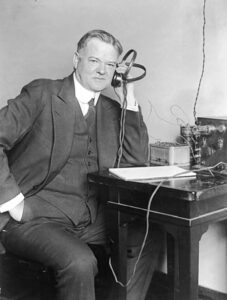
By Unknown author – Public Domain.
Five years ago it was my privilege to invite Herbert Hoover to become a member of the Advisory Council of the Society for the History of Technology. He accepted, with regret that his age prevented him from taking an active part in the affairs of the Society, and so he became one of us. It was characteristic of Mr. Hoover that he should have been reluctant to accept an honor if he felt that he could not give adequate service in return.
Yet it was we who were honored rather than Mr. Hoover. Not many learned societies can boast a President of the United States of America among their members, but that in itself would not have led us to seek him out. Herbert Hoover was a distinguished historian of technology long before the Society was even dreamed of. In 1912 he and Mrs. Hoover published in the Mining Magazine of London what has remained the classic English translation of Georgius Agricola’s De re metallic a, first printed in 15 5 6 and still our basic source of information on the mining and metallurgy of the Middle Ages and the Renaissance. Mr. Hoover wrote Principles of Mining ( 1909), the standard treatise of its day on the extraction of gold, silver, copper, lead, tin, and zinc, under conditions that most of us would consider unfavorable. This scholarly work was done during Mr. Hoover’s private career when, after graduating in 1895 with Stanford University’s first class, he rose from being a two-dollar-a-day laborer in a California silver mine to become a highly successful mining engineer and business executive, in the process moving constantly across the world.
During the long public career that followed, Mr. Hoover continued to demonstrate an appreciation of the importance of history and an awareness of the requirements of scholarship. Even while he was immersed in the turmoil of World War I and its aftermath, he was starting the collection that would become the Hoover Library on War, Revolution, and Peace at Stanford University, one of the world’s outstanding centers of research. His own involvement in philanthropy and government service turned his attention from engineering to political and international issues, but he never lost the good engineer’s awareness of the implications of an advancing technology. This awareness is apparent in his speeches and writings and in his work as Secretary of Commerce, when he created divisions in the department to deal with aviation, highway traffic, and radio broadcasting. It is evident, too, in the fact that he could add to his duties service as chairman of both the Colorado River and St. Lawrence Waterway Commissions and find time to raise funds for scientific research under the auspices of the National Academy of Sciences.
When he returned to historical writing in later years, he naturally and properly gave his attention to the events in which he himself had been a major participant and to the personalities with whom he had been associated. Books like An American Epic (1959-64), the four volume history of famine relief during the World War I, and The Ordeal of Woodrow Wilson ( 19 5 8) are further testimonials to Mr. Hoover’s own scholarship, even though they do not come within the scope of the history of technology.
It is needless to review here Herbert Hoover’s humanitarian work or his political career. Neither requires publicizing; both have been adequately discussed elsewhere. He had his triumphs and his defeats. He accepted both with the calmness of his Quaker heritage and was neither carried away by the one nor dismayed by the other. Few men in American public life have been subjected to crueler vilification; fewer still have endured it with greater dignity. A lifetime of achievement and service was sufficient answer to the critics, but there was impressive recognition as well. The mere numerical tally is astounding: 87 honorary degrees; 486 medals, awards, and honors; 86 honorary memberships in learned societies.
We mourn the passing of a great man who shared our interests, but we do so because the loss is ours. When a man has served God and humanity as long, as devotedly, and as well as Herbert Hoover did, we need not mourn for him.
John B. Rae
Previously published as John B. Rae, “Herbert Clark Hoover (1874–1964),” Technology and Culture 6, no. 1 (1965): 108–9, https://muse.jhu.edu/article/894783.
Rae, John B. “The Herbert Hoover Collection of Mining and Metallurgy.” Technology and Culture 21, no. 4 (1980): 614–16. https://muse.jhu.edu/article/890752.