
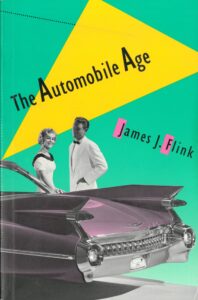
James J. Flink, The Automobile Age, (c) 1990 Massachusetts Institute of
Technology, published by The MIT Press.
Serious academic scholarship on the role of the automobile in the development of modern American life began in the 1960s with James J. Flink (1932–2021). There were many popular-market “buff books” on various aspects of motoring history prior to Flink’s work, and John Rae had already begun his long career investigating America’s automotive industry and infrastructure before Flink came along. But Flink was the first academic historian to focus on how twentieth-century American society shaped, and was in turn greatly shaped by, the automobile and everything that came with it: the industry itself, highways and byways, fuel supplies, regulations, parking and the urban environment, political and social alliances, and so forth.
There’s good reason why so many who have followed in Flink’s footsteps assume that he’s responsible for giving us the concept of “automobility.” It’s actually John Burnham’s term, but Flink’s focus on the broader realm of automobility is what set his work apart, and what set the stage for much of what would follow. It’s no accident that scholarly books on any aspect of American or global automobility published since his time invariably cite one or more of his books prominently in their footnotes. Such has been the lasting impact of his work.
His body of work is quite well-known, but Flink himself was a very private person. Gregory Thompson, a former student of his and one of the few who knew him well, graciously shared a few personal details. A native of Jolliet, Illinois, Flink briefly toured with a jazz band in the early 1950s before joining the U.S. Army. His stint in the military took him to California, where he married Iona Rogers in 1954. After his term of service ended the following year, he enrolled at San Francisco State College, where he developed an interest in social and economic history by way of extensive coursework with the influential business and economic historian Gerald T. White. He then studied under Thomas C. Cochran at the University of Pennsylvania, where he earned his Ph.D. in 1964. It was Cochran who first suggested to Flink that the history of the automobile was an underdeveloped area ripe for further exploration. Flink took this suggestion to heart. His doctoral thesis, “American Acceptance of the Automobile,” focused on the development of an automobile culture in the U.S. prior to the era of mass production.
Publishing a revised version of this dissertation with an academic press turned out to be a bit of a challenge, for none of the editors he spoke were eager to publish works on automotive history. Fortunately, though, Flink had developed a close collegial relationship with John Rae, who had already published two scholarly monographs on the history of the automobile and was close to finishing his third. With the help of a good word from Rae, the MIT Press decided to take a chance on Flink’s revised dissertation. Published in 1970 as America Adopts the Automobile, 1895–1910, the book was well-received. In a review for Technology and Culture, Lynwood Bryant praised Flink’s creative use of trade journals and popular magazines, and for opening the door to further studies of the impact of the automobile on American life. Bryant was less impressed with the book’s odd square formatting, as well as Flink’s decision not to delve into the development of automotive technology itself. His subsequent publications would appear in more conventional rectangular formats, but they would never spend much time on engines, gearboxes, or brakes. For what mattered to Flink early on would continue to motivate him throughout his career: the social, political, and economic context of the development of mass automobility, and not the car itself.
By the time America Adopts the Automobile was published, Flink had settled into a professorship in American and Comparative Culture at the University of California Irvine, where he spent the rest of his career. While working on a more sweeping history of the American car culture over the course of its first seventy-five-odd years, however, a personal tragedy struck which left an indelible mark on the resulting book. Published in 1975 by the MIT Press, The Car Culture carried an utterly devastating dedication: “To the memory of my niece, Tiffany Ann Rudd. Born December 11, 1969. Killed while at play by an automobile on May 1, 1971, my thirty-ninth birthday.”
Deliberately provocative, The Car Culture took the automobile to task for its deleterious effects on twentieth-century American society. As Lawrence J. White wrote in a review of the book for Technology and Culture, Flink held the automobile and its proponents “directly or indirectly responsible for the Great Depression, the decline of the family, the decline of the cities, the decline of rural America, and the encouragement of ‘privatism, materialism, escapism and exploitation.’” All of this was of course very much in sync with the times, for the early 1970s was an era of reckoning for American automobility. Highway fatalities, smog, the oil embargo, the industry’s quality and productivity problems, and even the 55mph speed limit—all of these pointed to a crisis for the way of life Americans had earnestly built since the turn of the century. Flink’s sobering analysis of the automobile’s impact therefore brought some much-needed intellectual heft to a broader pushback that had been taking shape for several years among activists and social critics. Indeed, Flink would later explain (in a wide-ranging interview conducted in 2012 with Gregory Thompson, later published in Mobilities in History in 2013) that The Car Culture was his most successful effort.
However successful it may have been, The Car Culture was surely not his most influential contribution. That distinction belongs to his final monograph, The Automobile Age. Published in 1988 by the MIT Press, it began with the earliest “precursors” to the car and ran up through the middle of the 1980s. But its primary focus was the 1920s through the early 1970s. For Flink, this fifty-odd year “automobile age” was the era in which the car truly shaped American political, social, cultural, and economic development. Prior to the 1920s, its impact was minimal; after the early 1970s, the broad reaction he participated in with The Car Culture meant that the transformative age of the automobile was receding.
Unlike The Car Culture, The Automobile Age was not a fiery polemic. It also was not limited to the American context. Instead it was a comparative work in which Flink extended his analysis to Europe, Asia, and other parts of the world. As Joe Corn noted in his review for Technology and Culture, the bulk of the book did still focus on the U.S., but its global framing shed welcome new light on automobility as a concept. The book’s comparative lens, Corn explained, “significantly demolishe[d] the myth, repeated by too many historians, that the American experience with the automobile has been exceptional.” Rather, Flink held that “the appeals of the car were universal, not culturally determined.” Seasoned SHOT members may bristle a bit at this not-so-subtle nod to technological determinism, but Flink was definitely onto something. Several decades of subsequent scholarship on automobility in other parts of the world have brought depth and nuance to our understanding of the role of the car in human life, but even today it’s rather hard to shake the notion that there’s just something about the personal car that has—as Henry Ford himself often suggested—a universal appeal.
While working on The Automobile Age, Flink was invited to work with Harold Skramstad and Steve Hamp on a comprehensive reconceptualization of the automotive collection at the Ford Museum in Dearborn, Michigan. That museum’s extensive inventory of historically-significant cars was previously crammed onto its floorspace like a giant indoor parking lot. Historical interpretation was minimal, and thus the broader context central to Flink’s approach was all but absent. The new exhibit, “The Automobile in American Life,” which opened in 1987, was entirely different. It still had a lot of cars, but they were now properly interpreted within their historical context. As Charles Hyde noted in a museum review for Technology and Culture in 1989, the new exhibit included a tourist cabin, a Texaco gas station, neon signs, photographs, and many other objects from the 1910s through the 1960s. It is no coincidence that this maps rather well onto Flink’s periodization of the “automobile age” in the book he was then finishing. To this day, “The Automobile in American Life” remains among the very best interpretive exhibits anywhere in the world. Flink’s intellectual imprint here is impossible to miss.
He also left his professional mark in other ways, including service on SHOT’s Advisory Council in the late 1970s and early 1980s, contributions to several televised documentaries, numerous reviews and essays, and the undergraduate and graduate students he mentored at UC Irvine. Throughout his career, he remained committed to the history of the automobile as a serious endeavor, and he often pushed back against the vast popular literature written by “car buffs.” Flink himself was anything but a car enthusiast. Indeed, as he explained in the aforementioned interview from 2012, he didn’t really care much for cars at all. He certainly had no use for antiques and classics and was much more interested in efforts to rejuvenate public transportation in the U.S. than he was in the latest and greatest from Detroit.
He also had a keen respect for what’s now known as the “work-life balance.” James Flink was serious about his work, and his lasting impact on the academic study of the automobile leaves no room to doubt his commitment to meticulous research, powerful argumentation, and the collegial development of synthesis and interpretation. But at the end of the day, automotive history was his job, no more, no less. When he retired in 1994, he was several chapters into a fourth book, this time on automotive design. But as he later explained to Gregory Thompson, he soon found himself wondering why he was still writing now that he was retired—“why do this when I can spend my time doing other things that are much more pleasant?” Once he realized that, indeed, he really didn’t want to do any of this anymore, he gathered up his notes and drafts, put them out with the trash, and settled into a long and quiet retirement in Santa Ana with his beloved wife Iona.
David N. Lucsko
Flink, James J. The Automobile Age. Cambridge, MA: MIT Press, 1988.
Flink, James J. The Car Culture. Cambridge, MA: MIT Press, 1975.
Bryant, Lynwood. Review of America Adopts the Automobile, 1895–1910, by James J. Flink. Technology and Culture 12, no. 4 (1971): 661–64. https://muse.jhu.edu/article/893577.
Flink, James J. America Adopts the Automobile, 1895–1910. Cambridge, MA: MIT Press, 1970.