
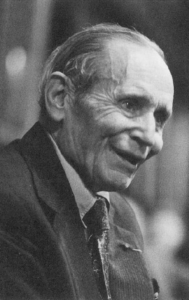
 John Ulric Nef has never been as familiar a figure to specialists in the history of technology as other early contributors to the Held, such as S. C. Gilfillan, A. P. Usher, Lewis Mumford, or William F. Ogburn. Like these other pioneers, Nef came to his interests in technology from a neighboring field, in his case, economic history. Nef’s most famous work, The Rise of the British Coal Industry, published in 1932, amassed statistics that altered our fundamental understanding of the Industrial Revolution.
Despite a demonstrated talent for specialized research, Nef never regarded himself as a specialist. He was a general historian, a man of letters with an abiding concern for the moral and cultural values of Western civilization. After publication of this book, his career was marked by ever-widening interests. In an unending quest for wholeness and unification of knowledge, he firmly resisted the mounting forces of specialization. His need for unity was typical of a generation that had experienced the social and cultural fragmentation engendered by World War I and the contemporaneous explosion of scientific knowledge into a myriad of discrete fields.
Nef knew of scientific specialization firsthand. His father was the eminent Swiss-born scientist, John Ulric Nef, Sr., founder of the University of Chicago Chemistry Department. Departing from his father’s career path and seeking broader understanding through history and the humanities, Nef undoubtedly gained from his father an abiding interest in the history of science and technology. When his father died in 1915, Nef became ward of his father’s colleague and friend, the philosopher G. H. Mead, eventually marrying Mead’s niece, Elinor Castle.
Nef transferred to Harvard, which had established the nation’s first program in economic history, after studying history for one year at Chicago. Heavily influenced by Harvard’s eminent economic historians Edwin Gay and Frank Taussig, he shared their broad parallel interests in social, political, and technological history. John Nef, Sr., and guardian George Mead both drew him to academe, but Nef resisted the conventional academic mold. After receiving his bachelor’s degree and pursuing one year of graduate study at Harvard, Nef chose to leave school and to study abroad on his own. In 1921, supported by substantial inheritances from both their families, Nef and his wife Elinor began a five-year European sojourn devoted to working and becoming “civilized.” Nef then undertook a daily regimen of research and writing on the coal industry. In Search for Meaning (1973), his autobiography, he also describes rapturously his immersion in the world of art. He befriended such painters as Paul Signac and Jules Pascin, acquiring a substantial collection of modern artworks well before their creators had become famous. Financially free to pursue his own course, he aimed to unify the creative arts and the humanities. Nef lived a life that was in itself an artistic creation, rich in beauty, friendship, and intellectual adventure.
Nef, while a voracious reader, belonged to a post-John Dewey generation that reveled in learning from life experience rather than books, a generation that sought to develop the “whole man”—body, spirit, and emotion as well as mind. Nef’s more personal writings reveal a passionately sensual nature, embracing aesthetics, love, and sexuality as much as the pleasures of rational knowledge. (Enjoying fine wine, he even published his own consumer’s guide, Confessions of a Wine Taster.) While interested in the broad theoretical generalizations of history, this sensuality and passion for living anchored him in the material world and, one suspects, reinforced his lifelong interests in science and technology. On European sojourn, Nef appeared to derive as much joy from climbing over the archaeological remains of saltworks and coal mines as visiting cathedrals and art museums.
This fascination with and direct knowledge of technological processes and inventions informed his Rise of the British Coal Industry, a scrupulously documented work, which, among other things, pushed back the dating of the Industrial Revolution from the late eighteenth century to the Elizabethan era. Nef first detected a sudden jump in the volume of the coal trade in that period. Linking coal mining to other key technologies of the Industrial Revolution, Nef’s study explored the evolution of metallurgy, the processes of invention, statistics on British patents, and technological transfer to and from France—in other words, much of what now falls within the modern specialty known as the history of technology. Nef also dealt with scientists of Restoration England, emphasizing their practical concerns and their service to British industry.
Nef’s monograph is an exemplar of the new economic history, intimidating in its detailed presentation of statistical data on British coal output. In the conclusion of his book, Nef spread his wings, speculating in new interdisciplinary directions and suggesting reciprocal relationships between the coal economy and “other sides of history . . . the history of price movements, of land tenure and agricultural technology, of invention and the natural sciences, of religious foundations and religious thought, and of parliamentary government.” A colleague warned him that his interdisciplinary approach was certain to offend sober specialists in the historical community.
Nef returned to the United States in 1926 and received his Ph.D. from what is now the Brookings Institution; his as-yet-uncompleted coal industry book became his dissertation. He taught for a year at Swarthmore, returning to the University of Chicago in 1928 as assistant professor in the already famous Economics Department. As the sole historian in a department of economists, Nef found himself left alone to pursue his interdisciplinary brand of research.
Nef remained an academic for the next thirty-five years but always saw himself as something of an outsider, objecting to the way specialization had taken command. Throughout his career, Nef vigorously advocated educational reform in graduate study. He dreamed of founding an interdisciplinary department to bring together humanists, scientists, and artists. Putting his own funds into the enterprise, Nef was able in 1942 to establish Chicago’s Committee on Social Thought, an institution that still exists. Despite faculty opposition, the committee became a degree-granting department with a permanent faculty of humanists and social scientists and a visiting faculty from music, art, and the experimental sciences. With his native genius for making friends with the famous names of his time, Nef was chair of the committee from 1945 to 1964. T. S. Eliot, Igor Stravinsky, Jacques Maritain, Marc Chagall, Hannah Arendt, and Artur Schnabel each joined Nef in Chicago, remaining close friends with him and his wife for many years. In 1958 and 1959, Nef established the Center for Human Understanding, an offshoot of the committee devoted to issues of world peace. Nef also hoped to establish a Supreme Court of the World to address world problems.
From comparative international studies on industrialization and politics, to atomic energy, and to the then-unconventional subject of the economic background to art, Nef’s scope of interests broadened. His writings also evidenced a growing social concern. Industry and Government in France and England, 1540—1640 (1940) compared the entwined political and economic histories of the two nations. His War and Human Progress (1950) was a response to World War II and the atomic bomb, disputing the established thesis that the greatest technological and scientific advances occurred under the pressures of wartime. Challenging Werner Sombart and others, Nef stressed the horrible disruptions of war. In The Conquest of the Material World (1964), Nef presented a fresh view of Western industry, exploring the relations between religion, science, politics, and technology in the rise of Western industry in search of a model for industrializing nations of the Third World.
Nef’s approach toward “integral history” and his Committee on Social Thought brought him international renown. After the Second World War, he was invited to lecture at the College de France and the Institut d’Etudes Politiques of the University of Paris. Fluent in French, Nef came to regard France as a second home.
After the death of Elinor, he married Evelyn Stefansson, widow of the famous explorer. Moving to Washington, D.C., in 1964, the urbane couple reestablished the salon Nef in their Georgetown town house, holding court to world-famous scientists, artists, and literati. Marc Chagall, their close friend, adorned their garden wall with a sumptuous mural. From accounts of those who knew him, the passion for life that Nef brought to the pursuit of history was his greatest gift to his profession. At a memorial ceremony, colleagues, students, and friends paid tribute to his erudition and inspired teaching, but most of all they recalled the exquisite pleasures of food, wine, and conversation at the Nef dinner table. John U. Nef was a historian who savored life.
Arthur P. Molella
Polella, Arthur P. [sic] “John U. Nef (1899–1988).” Technology and Culture 31, no. 4 (1990): 916–20. https://dx.doi.org/10.1353/tech.1990.a901687.
Rosenband, Leonard N. “John U. Nef, The Conquest of the Material World.” Technology and Culture 44, no. 2 (2003): 364-370. https://dx.doi.org/10.1353/tech.2003.0087. [Classics Revisted]
“The Leonardo da Vinci Medal.” Technology and Culture 21, no. 3 (1980): 437-445. https://muse.jhu.edu/article/890708.
Nef, John U. The Conquest of the Material World. Cleveland: World Publishing, 1964.
Nef, John U. War and Human Progress. N.P.: Russell and Russell, 1950.
Nef, John U. Industry and Government in France and England, 1540—1640. Philadelphia: American Philosophical Society, 1940.
Nef, John U. The Rise of the British Coal Industry. 2 vols. London: Routledge, 1932.