
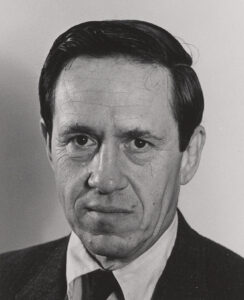
 Leo Marx was born on November 15, 1919, in his family’s apartment in Manhattan. He died on March 5, 2022, in the Jamaica Plain neighborhood of Boston, where he shared a two-family house with his daughter and her family, not far from the homes of his two sons. In the century between, Leo Marx went from an unsettled childhood to becoming an internationally recognized scholar and teacher, beloved and respected by countless friends, family, and colleagues.
As a scholar, Leo Marx is best known for his 1964 book The Machine in the Garden: Technology and the Pastoral Ideal in America. The subtitle suggests the complexity of his argument. The pastoral ideal goes back many centuries to ancient Rome and relies upon literary language and examples. The word and concept of technology, however, go back for little more than a century and relate to practical, money-making enterprises. How could these two approaches to human experience coexist to shape American history?
This fundamental tension is the theme of The Machine in the Garden. In the words of Marx’s MIT friend and colleague Merritt Roe Smith, “From Day One, The Machine in the Garden was considered a history of technology classic.” It was also a classic in American Studies and in History and Literature. Marx was among the first to practice deeply interdisciplinary scholarship, in highlighting the role of literary evidence and analysis in understanding the history of technology.
It took many years and a variety of life experiences on two continents for Leo Marx to develop a new model of interdisciplinary scholarship. His mother, Theresa Rubenstein, known as Tess, had married at the age of 17 and was the mother of a ten-year-old daughter when her son Leo was born. Their father was one of eleven children, most of them active in New York business and politics. When Leo was five years old, his father died suddenly, at the age of 35, apparently of a heart attack following a bout of scarlet fever.
Little Leo, five years old, was left with only the vaguest memories of his father. His widowed mother, bereft and depressed, continued to live in the family apartment in Manhattan, but for months at a time she would take the children to live on Long Island. One year Tess took the children to Paris, where her sister had married a Frenchman who became staff director at the Ritz Hotel. Tess and the children lived in an apartment on the Right Bank across the Seine from the Eiffel Tower. Leo quickly picked up the language, but outside of school he had no playmates to speak of.
Leo eventually spent two years in Paris—often hanging around the Ritz—but for the most part he grew up in New York. His happiest times were spent with the Boy Scouts. He joined an especially active troop, with whom he became a swimming instructor, rode horses, camped out in New Jersey, and attained the rank of Eagle Scout.
These experiences were to blossom into Leo’s lifelong enjoyment of the great outdoors. He acquired a deep knowledge of flora and fauna, especially birds. When he was well into his 80s, on a visit to Oxford University, Leo took long walks with his old academic friend, Alan Trachtenberg, discussing not American history and literature but the differences between American and European robins.
In his high school years, Leo’s academic record was so poor that his application to the City College of New York was rejected. Because of a lucky break—a random conversation with the New York police commissioner who asked about his plans—Leo applied to Harvard with a recommendation from the commissioner. There he was accepted—and never ceased to be grateful to the person in power who gave him a helping hand. Among the many letters of condolence received by his family upon his death, many mentioned how Leo had written a letter or put in a good word for the writer, often unsolicited, and sometimes with life-changing consequences.
At Harvard College, Leo concentrated in History and Literature, a new interdisciplinary degree program. He was active in leftwing politics and became editor of The Harvard Progressive. When he graduated magna cum laude in 1941, the world was at war. Rather than waiting to be drafted, Leo joined the United States Navy and was immediately sent to a program to be trained in navigation. Upon completing it, he was assigned to the crew of a sub chaser. The vessel was imposingly named Mighty Hunter but was the smallest commissioned ship in the Navy (twenty-five men), made of wood so that it could not itself be chased by magnetically-guided torpedoes. Leo was the youngest person on board.
Leo served four years on this sub chaser, initially in the Caribbean and Atlantic, and later in the Pacific off Pearl Harbor. In his third year of service, in 1944, he spent part of a shore leave in California getting married to Jane Todd Pike. They had met in college, where they were both active in leftwing politics. At the time of their graduation, on a farewell walk along the Charles River, they agreed to keep in touch by writing each other regularly. Jane wrote Leo every single day of the war, and he wrote as often as he could. Their correspondence eventually ran to hundreds of pages. Leo’s daughter often read from them to him in his old age after Jane’s death.
When the war ended in 1945, Leo was still the youngest person on Mighty Hunter, but he had risen to become the ship’s captain. He had also seen a lot of history and had decided to become a historian. Once admitted to the Graduate School of Arts and Sciences at Harvard, Leo and Jane moved into a small, ratty apartment on Beacon Hill. Their two sons were born there while Jane did social work and Leo worked to earn a doctorate in a new Ph.D. program called the History of American Civilization.
The name of the program conveys a triumphant sense of American identity in the immediate postwar period. The United States was not just a nation-state, but a “civilization,” armed with cultural and technological power. Leo had been intrigued by the connection between these two types of power as they intertwined in the story of American industrialization. He decided to make his dissertation an account of early responses to this industrialization.
By 1949, he had completed his Harvard doctorate and accepted a job offer from the English Department at the University of Minnesota. There Leo divided his time between undergraduate teaching and working on his dissertation project. In 1956–57, Leo received a Fulbright fellowship, which took him as a visiting lecturer to the University of Nottingham. Upon returning to Minnesota, Leo accepted a speaking engagement at Amherst College, which led to an offer in 1958 to join the Amherst faculty as a Professor of English and American Studies.
Leo was almost forty years old and was still revising his dissertation. He arrived at Amherst College with a draft of the book, expecting to get it published soon. First, though, he asked one of his new Amherst colleagues, Benjamin DeMott, to read the manuscript. DeMott did so and responded to Leo with this assessment: “This is a good book about other books. If you make it into it into a book about America, you will have a great book.”
Leo was discouraged but concluded that Mott was right. His situation at Amherst College afforded relative simplicity and flexibility. He had no graduate students, research assistants, or teaching assistants to support or supervise. He focused his attention on revising his dissertation. Once it was published, he had multiple offers of writing and editing to respond to. He also remained engaged with writing and editing while winning scholarly honors (such as election to the American Academy of Arts and Sciences) and assuming scholarly responsibilities (for example, as President of the American Studies Association).
Most of all, though, at Amherst Leo focused on undergraduate teaching. In this role he became legendary. He delivered lectures with flair and passion, some of them evoking standing ovations from the students. His skills as a teacher went much further and deeper than lecturing. In remembering Leo, countless former students praise him above all for listening to them. The conversation would be above all about their questions and concerns.
Many of those comments related to their choice of language. Leo would ask students what they meant when they used keywords like “nature,” or “technology,” whether in speaking or writing. For written assignments, he would make detailed comments and suggestions. Listening, thinking, writing: these were the three pillars of Leo’s academic life for eighteen years at Amherst College.
Eventually, Leo Marx was ready for new adventures. In 1975, MIT President Jerome Wiesner and MIT Provost Walter Rosenblith invited Leo to come to MIT to help develop a program in technology studies there. They wanted to create a “College of Science, Technology, and Society,” connecting MIT’s existing schools in an ambitious mission that would include an undergraduate program, research center, and graduate fellowships.
For Leo, the offer presented a unique opportunity to organize a technology studies program around the humanities. He was attracted to a program that did not assume a definition of “technology” from the outset. The offer also appealed to Leo and Jane for practical reasons. If they moved to Boston, there was a better chance of remaining near their families as everyone got older.
In early 1976, Leo Marx joined the MIT faculty as the William R. Kenan Jr. Professor of American Cultural History. The opportunity at MIT had been described to him, only half-jokingly, as a chance to build a “New Jerusalem.” Leo found instead, in his own more than-half-joking words, a “lion’s den.” Plans for the new College had ignored the existence of MIT faculty already involved in a similar Technology Studies program. Despite constant proposal-writing by Leo and others, non-profit foundations provided less support than what was anticipated and needed.
Finally, although he and many of his colleagues had been known as outstanding teachers, their talents were not well-suited to the mindset and curricular demands of many MIT undergraduates at that time. An ambitious experiment in an introductory “window” course lasted five years until being cancelled in 1982. Wiesner and Rosenblith had retired from MIT leadership two years earlier. Aspirations for a College subsided with their departure. What was left was a Program in Science, Technology, and Society, a high quality but small department within the existing School of Humanities and Social Science, short on funds and clout.
What got STS through this period, when the existence of the Program was being challenged, was the strength and unity of its senior faculty. During those times, Leo Marx was, in the words of Sherry Turkle, an STS colleague, “the intellectual heart and soul of the STS program, in large part because he believed in it so much.” The STS faculty came to realize that a graduate program was necessary to attain stability and respectability at MIT. In 1987, the STS Program faculty got provisional approval for a joint doctoral program with History and Anthropology. In the 1990s, the joint doctoral program was launched. The Program in Science, Technology, and Society began to recover from the rocky times of the 1970s and 1980s. Along with the HASTS doctoral program (History, Anthropology, and STS), the STS Program at MIT has not just survived but has thrived.
This stabilization took hold when Leo Marx had been at MIT for fourteen years. In 1990, he was subject to a mandatory retirement age, just a few months before the mandate was eliminated as a form of age discrimination. Leo’s childhood had required him to be adaptable: the lesson was well learned. From 1990 on, he adapted his teaching and research program so that he kept active and productive for almost another quarter century.
One adaptation involved teaching mostly graduate students. Most of these students came from MIT, but not necessarily from the HASTS joint program. Other students came from other graduate programs around the Institute, and also an increasing number came from Harvard University. For every graduate class meeting, students wrote response papers, commenting on and raising questions about the assigned readings. The classes would be organized around the students’ presentations of their response papers, as Leo would jot down key words and phrases. The class discussion would take off from there, with Leo providing prompts and comments and further relevant material. He felt that The key to making the class click was to make it a collaborative experience, with students being the major source of material for discussion.
For written assignments, Leo would provide a fairly detailed summary of topics the students might discuss. His standards for good writing were clear and high. He had an unerring eye for specialist jargon, which he attacked mercilessly, along with unsound logic or wobbly arguments. He would give the same careful reading to other papers or dissertation chapters that graduate students asked him to review. When David Mindell was a graduate student at MIT, he asked Leo to review a paper and got back eleven pages of handwritten comments. He was told that this was a good sign—evidence that Leo took him seriously. He later reflected, “One could not ask for a kinder, gentler person to slice a young scholar’s early writings to the bone. He made me a better writer, a better thinker, and a better historian, and left similar marks on many others.”
Leo Marx also adapted his teaching and research to the larger shift of the times towards environmental studies. As time passed, the themes of The Machine in the Garden spread far beyond American Studies and imaginative literature. The whole interdisciplinary area known as environmental studies, taking shape in the 1980s, became a dominant intellectual theme of the new millennium.
Leo Marx began to shift to environmental studies in the 1990s. Along with Jill Ker Conway and Kenneth Keniston, he wrote and administrated a grant that led to a multi-year lecture and discussion series and eventually to a book Earth, Air, Fire, Water: Humanistic Studies of the Environment intended for a general audience. Leo began to write other articles reconsidering the concept of nature (such as: “The Idea of Nature in America”). “The environment” came to be the place where “nature” and “technology” converged.
At the same time “nature” was being recast as “environment,” the idea of technology was also being redefined. The concept of “technology” became more and more dominant as technological change increasingly seemed to be the only kind of change that mattered in history. The concept was also becoming ever more narrow, as “technology” was commonly equated only with digital devices and systems.
For many decades Leo had been exploring the word and concept “technology,” in such articles as ones on Heidegger’s essay “The Question Concerning Technology,” on technological pessimism, and on the concept of progress. Just before the turn of the millennium, he wrote an article, published in Social Research in 1997, explaining how and why “technology” had become a “dangerous concept.” John Staudenmaier, editor of Technology and Culture, relentlessly pursued Leo to get him to write a revised version for publication in his journal, where it would come to the attention of more historians of technology. “Technology: The Emergence of a Hazardous Concept” appeared in the July 2010 issue of Technology and Culture and became the most-cited article at that time in the history of the journal.
Leo Marx sometimes regretted that his move from Amherst to MIT came to mean that moved away from literary studies, because MIT students for the most part were not interested in literature except at best as a sideline. He admitted that at times he felt “pinned down” by his famous book. But in a way he did write a second book—an intellectual history of the concepts of “technology” and “progress”— not as a bound volume, but as chapters, articles, talks, and essays, not planted in a row but distributed like scattered seeds, to use a pastoral metaphor.
The move to MIT gave Leo more of a global audience. While thoroughly at home in the traditional classroom, in his retirement years he made the world into his classroom. He did an enormous amount of public speaking, mentoring, editing, advising, and intervening in all sorts of conversations. He was known for asking penetrating, perceptive, memorable questions in settings where they were expected and also in settings where they were not.
Leo’s international upbringing reemerged in his old age. For someone long identified as an “Americanist,” he had an international following, especially in Europe. Norway, Denmark, Sweden, the United Kingdom, the Netherlands, Germany, France, Spain, Portugal, Austria, Italy—there are few if any European nations that he did not visit for a conference or lecture. He was recognized as someone who worked with American sources to speak about issues that had no national boundaries. Again to quote Roe Smith: Leo Marx’s “quality of mind was exhibited again and again in public settings. He had the extraordinary ability to ask very perceptive, penetrating questions.”
In a 2006 email to a colleague, Leo Marx mused on his continuing dissatisfaction with conventional modes of teaching and writing. “I guess it is almost a definition of the ‘academic’ to stop the discussion at the border between the demonstrable, descriptive facts and their implications—their larger meaning.” He for one kept crossing that border, from evidence to implications, insisting that value-free knowledge was an illusory and unworthy goal. If anything his insistence on asking “so what?” got stronger in the last quarter century of his life. Far from being an aftermath, it is a distinct and productive period, with enormous influence around the world: a memorable finale to Leo Marx’s remarkable century of life.
Rosalind Williams
Marx, Leo. “Technology: The Emergence of a Hazardous Concept.” Technology and Culture 51, no. 3 (2010): 561–77. https://dx.doi.org/10.1353/tech.2010.0009.
Meikle, Jeffrey L. “Leo Marx’s The Machine in the Garden.” Technology and Culture 44, no. 1 (2003): 147–59. https://dx.doi.org/10.1353/tech.2003.0036.
Marx, Leo. “The Idea of Nature in America.” Daedalus 137, no. 2 (2008): 8–21. https://doi.org/10.1162/daed.2008.137.2.8.
Marx, Leo. “‘Technology’: The Emergence of a Hazardous Concept.” Special Issue: Technology and the Rest of Culture. Social Research 64, no. 3 (1997): 965–88. http://www.jstor.org/stable/40971194. [An early version of the T&C article: “Technology: The Emergence of a Hazardous Concept.”]
Conway, Jill K., Kenneth Keniston, Leo Marx, eds. Earth, Air, Fire, Water: Humanistic Studies of the Environment. Amherst: University of Massachusetts Press, 1999.
Woodman, Harold D. Review of The Machine in the Garden: Technology and the Pastoral Ideal in America, by Leo Marx. Technology and Culture 6, no. 4 (1965): 661–64. https://muse.jhu.edu/article/894654.
Marx, Leo. The Machine in the Garden: Technology and the Pastoral Ideal in America. Oxford: Oxford University Press, 1964.