
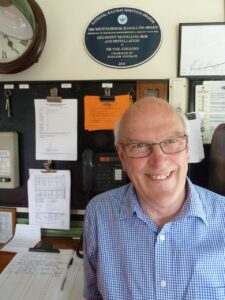
Sir Neil Cossons in front of a plaque recording the award he made to the Grosmont Signalling Box. Photo courtesy of Anthony Warren.
Sir Neil Cossons (1939–2026) was the most prominent advocate for the cultural and historic significance of industrial heritage throughout the world, a role reinforced by his joyous and infectious enthusiasm for the subject.
Neil’s birthplace, Beeston in Nottinghamshire, had once been a major centre for the manufacture of silk, lace and hosiery; he always retained an appealing tinge of a Nottinghamshire accent. He was powerfully influenced by his father, Arthur Cossons, a headmaster and enthusiastic local historian, who took his children to visit industrial sites. Neil’s own interest in transport was fired by his father’s collection of eighteenth- and nineteenth-century books on turnpike roads.
In 1958 Neil went to Liverpool University to read geography, where he met his wife, Veronica Edwards, also a geography student. He became a founder member of the Liverpool University Public Transport Society (LUPTS) and edited its journal. Trams were his particular interest but he became increasingly captivated by other forms of transport, regularly visiting trolleybuses, railways and airports. With LUPTS he went to Glasgow to ride on and help towards the purchase of a former Liverpool tram. This vehicle is now at the National Tramway Museum in Crich, Derbyshire; he was to serve as President of the Tramway Museum Society. He was a keen photographer and walked the city streets of Liverpool recording its industrial and sea-faring heritage. He later co-authored ‘Liverpool: Seaport City’ with Martin Jenkins, a fellow LUTPS member.
After university, Neil became a graduate trainee at Leicester Museum. Part of his training was the stuffing of a squirrel, and he described in gleeful detail the process which resulted in a grotesquely misshapen end result. However, he eventually found a more congenial role, writing his first published work, a pamphlet for the museum on the contractors’ locomotives of the Great Central Railway. It has a brief and elegant introduction and exact specifications of all the locomotives illustrated.
In September 1962, Neil attended an early conference on industrial archaeology in Shropshire, which included a field trip to Ironbridge and Coalbrookdale. That conference was a revelation, convincing him “that my career in museums should . . . be concerned . . . with the history and archaeology of industrialisation and its associated structures and technologies.” In 1963, he joined the Newcomen Society for the History of Engineering and Technology. After a short stint as assistant curator for the Swindon Museum Service, he moved in 1964 to become Curator of Technology at Bristol Museum. This was the moment the nascent information architecture (IA) movement was gathering momentum via a series of annual conferences held in Bath and Bristol from 1964–1970. The conferences were co-organised by Neil from 1966.
These conferences brought together the major pioneers in the field, notably Michael Rix, Angus Buchanan, Kenneth Hudson, L.T.C. Rolt and Arthur Elton, as well as Marie Nisser, the distinguished industrial historian from Sweden and Robert Vogel, Curator of Mechanical and Civil Engineering at the Smithsonian Institution in Washington DC. Out of these conferences were born the Society of Industrial Archaeology in America (1971), co-founded by Robert Vogel, and the Association of Industrial Archaeology in Britain (1973). In 1968 Neil moved back to Liverpool to become Deputy Director of its Museum at the young age of 29. From here he might have risen conventionally through the museum service, but in 1971, he took a sideways but surely irresistible step to become the first director of the Ironbridge Gorge Museum established and financed by the Telford Development Corporation.
Unlike other open-air museums, Ironbridge comprised an historic industrial landscape complete with furnaces, engine houses, warehouses, and workers’ housing. The 1777 furnace in Coalbrookdale, built by Abraham Darby III to make castings for the Iron Bridge, had been excavated in the 1950s and there was also a small museum marking 250 years of the Coalbrookdale Company, but many of the other surviving features were derelict. Neil rapidly expanded this core into a viable museum spread over three miles which “threaded [the monuments] together into a narrative so that visitors could approach it from any angle.” The Museum opened in 1973. Back in 1968 my father, Arthur Elton, put on an exhibition in Manchester entitled, “Art and the Industrial Revolution”; most of the exhibits were drawn from his own collection. When he died in 1973, the collection with its library, its pictures and its engineering commemoratives running into thousands of items, was offered in lieu of death duties. Neil immediately realised its value to Ironbridge, seeing in it “the essential synergy of the origins of industrialisation, which the Museum sought to articulate, [giving] a powerful visual expression of its wider inferences.” With the support of the Museum Trustees and the Museums and Galleries Commission, the Government was persuaded to allocate the Elton Collection to Ironbridge, thus providing the Museum with an essential research facility to underpin its industrial artefacts.
Under Neil’s leadership, the Ironbridge Gorge Museum became a catalyst for the growing understanding of industrial history. It received the National Heritage Museum Award in 1977, and in 1978 was the first recipient of the European Museum of the Year Award. In 1978, the Ironbridge Institute opened in collaboration with Birmingham University, offering the first courses on IA in Britain, in addition to which there were memorable conferences and exhibitions run by the Museum itself. In 1979, Neil collaborated with Robert Vogel to mount an exhibition at the Smithsonian Institution in celebration of the bi-centenary of the opening of the Iron Bridge, the world’s first major iron structure. In 1986, the Ironbridge Gorge was inscribed on UNESCO’s World Heritage List, the first industrial site in Britain to be so honoured and only the second industrial site anywhere.
In 1983, Neil became Director at the National Maritime Museum in Greenwich, though he was completely open about taking the Science Museum Directorship if it came up. While he was at Greenwich, he managed to change the mindset of the Museum from one of process to one of progress, but then the Science Museum job did indeed come up and 1986 he was appointed Director. He had always believed in the supreme importance of collections and wanted to engage visitors by the imaginative exhibition of historic industrial artifacts rather than by “rows of murky and incomprehensible mechanisms, poorly interpreted, and badly displayed.” He put this vision into practice with the Making of the Modern World gallery, brilliantly demonstrating, via 2,000 artefacts, achievements in engineering and science over 250 years. He was knighted in 1994.
From 2000 to 2007, Neil was Chairman of English Heritage. This government body was established to champion the historic environment and was responsible for advice, policy making and the statutory listing of buildings and monuments, managing many of them. He found himself responsible for a wide range of structures from Stonehenge onwards and ran up against government ministers in his campaign to preserve the department’s funding. He was clear that the historic environment also included small-scale buildings and streetscapes, a view surely nurtured years before when he was photographing such places in Liverpool. This view was embodied in the policy document Power of Place; Neil led the steering group which produced it. However, he never lost his focus on IA, inspiring for example the acquisition by EH of the late-Victorian workshop of J.W. Evans & Co. in Birmingham.
Neil’s unwavering belief in the value of industrial heritage embraced the world. In 1973, the newly-opened Ironbridge Gorge Museum hosted the First International Conference on the Conservation of Industrial Monuments, out of which emerged in 1977 the International Committee for the Conservation of the Industrial Heritage (TICCIH). His international outlook was exemplified in his relationship with Japan. In 1998, as Director, he was actively involved in a travelling exhibition, ‘Treasures of the Science Museum’ which toured three Japanese cities. There were 60 exhibits including the first Orrery made by John Rowley for the Earl of Orrery, the prototype spinning machine of Richard Arkwright and John Kay, and Robert Stephenson’s ‘Rocket’ locomotive. These and many other items had never before left Great Britain. The exhibition led to his long-term relationship with Japan, and his contribution to an impressive example of international cultural co-operation was demonstrated through the UNESCO World Heritage nomination of the ‘Sites of Japan’s Industrial Revolution: Iron and Steel, Shipbuilding and Coal Mining’. He acted as an advisor to the Japanese government and was instrumental in building confidence among stakeholders through repeated visits and face-to-face engagement. He addressed concerns raised by politicians, government agencies and institutions, and helped to navigate a range of challenges, maintaining momentum towards inscription. His diplomatic skills, credibility, persistence, and patience were critical in securing broad support. The sites were inscribed on the World Heritage list in 2015. In 2024, the Japanese Government awarded him the Order of the Rising Sun. Established in 1875, the Order was the country’s first national decoration.
Despite his distinguished and busy career, Neil kept in touch with the industrial archaeology and engineering history communities, serving as President of the Association for Industrial Archaeology and of the Newcomen Society. He also chaired the ground-breaking first Early Railways Conference, giving as his keynote address a scholarly survey of pre-steam railways, which set the scene for this and subsequent conferences. The point about this is that he was not just an outstanding museum executive, but really knew his stuff. He published many books and papers including “Industrial Monuments in the Mendip, South Cotswold and Bristol Region,” “Ironbridge: Landscape of Industry,” The BP Book of Industrial Archaeology, and Perspectives on Industrial Archaeology.
For he remained at heart a hands-on enthusiast, endlessly fascinated by the myriad examples of human skill and ingenuity that he encountered during his career. In the last weeks of his life, when he was bed-bound, a friend took a working model of a hot air engine on the Stirling Cycle to amuse him. Her burner was filled and transferred to the firebox and she gradually warmed up. Neil, judging the moment perfectly, stretched out his hand to gently move the flywheel, whereupon the engine sprang into action. As so many, many times before, his face lit up and his eyes sparkled with delight.
Dr. Julia Elton (2026)
Past President of the Newcomen Society for the History of Engineering and Technology
Cossons, Niel. Perspectives on Industrial Archaeology. London: Science Museum, 2000.
Bryden, D. J. “Review of The Iron Bridge, Symbol of the Industrial Revolution, by Neil Cossons, Barrie Trinder, and: A View from the Iron Bridge by Stuart Smith, and: Iron Bridge to Crystal Palace: Impact and Images of the Industrial Revolution by Asa Briggs.” Technology and Culture 22, no. 2 (1981): 306–10. https://dx.doi.org/10.1353/tech.1981.a890852.
Cossons, Neil, and Barrie Trinder. The Iron Bridge, Symbol of the Industrial Revolution. Chichester: Phillimore, 1979.
Cossons, Niel. The BP Book of Industrial Archaeology. 3rd ed. London: David and Charles, 1975.
Rolt, L. T. C. “Review of Mines, Mills and Furnaces: Industrial Archaeology in Wales, by D. Morgan Rees, and: The Industrial Archaeology of the Bristol Region by R. A. Buchanan, Neil Cossons, and: The Industrial Archaeology of Bath by R. A. Buchanan.” Technology and Culture 11, no. 4 (1970): 633–35. https://dx.doi.org/10.1353/tech.1970.a894059.
Buchanan, R. A., and Neil Cossons. The Industrial Archaeology of the Bristol Region. Newton Abbot: David and Charles, 1969.