
We are still looking for a picture of Dr Woodbury.
Bob Woodbury, the first treasurer of SHOT and professor of history, emeritus, at MIT, died in Needham, Massachusetts, on September 18, 1983.
Born in Boston, he attended the public schools of Winchester, Massachusetts. He was a student at Swarthmore College, specializing in philosophy and literature, before transferring to MIT, where he received his B.S. degree as a mathematics major in 1928. In 1936 he received a master’s degree in history from Harvard. He became an instructor in English and history at MIT in 1929 and assistant professor in 1936.
Professor Woodbury was an officer in the Naval Reserve and was called to active duty in 1940. He served as torpedo officer on the Atlantic Fleet destroyer staff and helped organize and was commanding officer of the destroyer force’s torpedo officers’ school. In 1945—46, he was flag secretary and fleet administrative officer of the Seventh Fleet. For his service he received the Legion of Merit.
He returned to MIT in 1946, where he became associate professor in 1959 and full professor in 1963. He retired in 1972. He was on leave in 1948—49 as director of Naval Reserve Research and in 1957 as curator of engineering at the National Museum of History and Technology. In 1969—70, he was visiting professor at the Georgia Institute of Technology.
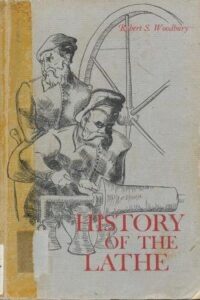
Woodbury was a dedicated student of the history of engineering. His course in the subject was a long-standing and popular fixture in the humanities program at MIT. After his return from naval service he undertook a history of machine tools, with the aid of a grant from the Willkie Foundation. Four monographs resulted, of which one, The History of the Lathe to 1850, was published by SHOT in 1961 as the first of the society’s Monograph Series. The others were published by MIT: History of the Gear-cutting Machine (1958), History of the Grinding Machine (1959), and History of the Milling Machine (1960). He was also the first recipient of the Usher Prize for his article “The Legend of Eli Whitney and Interchangeable Parts,” published in volume 1 of Technology and Culture (1960).
Professor Woodbury was frequently involved in controversy. However, I found him to be a friendly and helpful colleague. He made significant contributions to the history of technology with a high standard of scholarship. He left SHOT after a few years, but his service as treasurer during the society’s early days entitles him to our grateful recognition.
John B. Rae
Originally published as John B. Rae, “Robert S. Woodbury (1907–1983).” Technology and Culture 25, no. 4 (1984): 911–12, https://dx.doi.org/10.1353/tech.1984.a889988.
Woodbury, Robert S. Studies in the History of Machine Tools. Cambridge, MA: MIT Press, 1973.
Forbes, R. J. Review of History of the Lathe to 1850, by Robert S. Woodbury. Technology and Culture 3, no. 3 (1962): 312–13. https://muse.jhu.edu/article/895133.
Woodbury, Robert S. “The Scholarly Future of the History of Technology.” Technology and Culture 1, no. 4 (1960): 345–48. https://muse.jhu.edu/article/895611.
Woodbury, Robert S. “The Legend of Eli Whitney and Interchangeable Parts.” Technology and Culture 1, no. 3 (1960): 235–53. https://muse.jhu.edu/article/895632. [Usher Prize winner.]
Woodbury, Robert S. The History of the Lathe to 1850. Cleveland: Society for the History of Technology, 1960.
Woodbury, Robert S. History of the Milling Machine. Cambridge, MA: MIT Press, 1960.
Woodbury, Robert S. History of the Grinding Machine. Cambridge, MA: MIT Press, 1959.
Woodbury, Robert S. History of the Gear-cutting Machine. Cambridge, MA: MIT Press, 1958.