
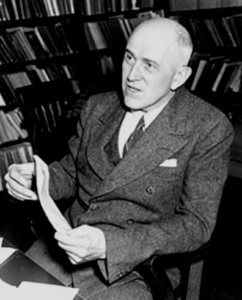
 William Fielding Ogburn, shortly after being elected the first president of the Society for the History of Technology, died on April 27, 1959, following a brief illness. His loss was felt not only by the new Society, which he was instrumental in founding, but also by a large segment of the world of learning, for at the age of seventy-two Ogburn continued to be active in many fields of research as he had been throughout his long and distinguished career.
Ogburn’s contribution to knowledge concerning technology and social change can best be understood in the context of his work as a whole. To begin with, he was not a specialist, although he often commented on the necessity of intellectual specialization in an age of accelerating increase in the volume of knowledge, and the great range of his interests can only be indicated briefly. His early research concerned the history of social reform legislation and determinants of voting behavior-topics not unrelated to his political sympathies. Two years in government service around the end of W odd War I led to notable contributions on measurement of the cost of living and analysis of consumer expenditures. Somewhat earlier, he had developed the strong interest in psychoanalysis which he was to maintain throughout his life and to use effectively in studies on the problem of bias in science. A pioneer in the application of statistical methods to sociological, economic, and political problems, he served as editor of the Journal of the American Statistical Association from 1920 to 1926 and later as president of that organization. His many investigations in social statistics led to noteworthy studies on marriage and the family, demography, social concomitants of business fluctuations, and variation in the social characteristics of cities.
At a relatively early age Ogburn had drawn up for himself a list of what he called the “great questions,” as, for example: How does an animal with the original nature of a cave man adapt to life in the modern city? Do great men influence the course of change independently of social forces? Can human happiness be increased by improving child training practices? A number of such issues were brought into juxtaposition in the small volume that has become a sociological classic, Social Change with Respect to Culture and Original Nature (1922, reissued in 1950 with a supplementary chapter, “Social Evolution, Re-considered”). Much of Ogburn’s work in the following years consisted of variations and elaborations on themes stated in this book.
Many sociologists feel that Ogburn’s principal impact on social science derived from his tireless insistence on verification and the need to replace literary and speculative approaches by systematic research using quantitative data and statistical techniques. Yet, particularly where his own major substantive interest-social change -was involved, he never became preoccupied with techniques for their own sake. In a personal letter of July 14, 1958, he wrote: “My interest in social change, looking at the matter personally and remembering the adage de gustibus non disputandum est, has been largely on significance and meaning rather than on methodology. I have a tendency to try to see what I call ‘ big ideas ‘ or develop a sense of the significant.” In this respect, as in many others, he displayed more than one facet of a versatile mind and a complex character. The emphasis on science as an accumulation of factual knowledge with high reliability, coupled with a virtual disdain for what he called “scholarship” and “intellectualism,” may be seen in his own statistical studies of social trends, the series of annual symposia on ” Recent Social Changes ” which he edited for the American Journal of Sociology (1928-35, 1942), and the monumental Recent Social Trends ( 1933), a collective undertaking of which he was research director. In contrast, in much of Social Change, as well as such noteworthy articles as “The Great Man Versus Social Forces” (1926), “Stationary and Changing Societies” (1936), “Inventions, Population and History” (1942), and ” Sociology and the Atom ” (1946), there is manifest a willingness to set forth broad, synthetic generalizations, to use deductive argument where data are scanty, and to engage in bold, albeit disciplined, speculation. Indeed, it is not fanciful to discern in much of Ogburn’s writing a fortunate tension between the requirements of science as he understood them and his impatience to formulate powerful explanatory principles.
At the risk of distortion through oversimplification, we can summarize Ogburn’s contributions to the study of technology and social change under five major headings.
The theory of (1) cultural evolution was worked out in the years following 1914, when Ogburn was heavily influenced by the anthropologists Boas, Lowie, and Kroeber. While he had previously been impressed with the possibilities of eugenics, he now concluded that the mainsprings of social change are to be found in superorganic, not organic evolution. Taking technological development as a prototype, he identified invention as the basic source of social change. Granting that inventions often are associated with the exercise of superior mental ability, he supposed that mental ability is a nearly constant factor. While demand for invention channels inventive effort, the more important role of demand lies in determining uses made of inventions. More fundamental than either of these is the accumulation of previous inventions-the culture base-since inventions are primarily recombinations of existing culture elements or modifications of them. There is a certain inevitability about inventions: they come forth when the accumulated culture base is adequate, as is shown by the frequency of simultaneous, independent inventions. The accumulation tends to be exponential, because the number of possible new combinations of culture elements increases with the size of the culture base. Diffusion of culture-the spread of inventions from one area to another-hastens cultural evolution by making the total culture base more widely available. Finally, inventions in one part of culture instigate inventions in others. The parts of culture are interrelated, and changes in one part call forth adaptive changes in the parts related to it. Quite often, at least in modern times, the initial inventions are technological, and the adaptive changes are in institutions and social structure. “Social inventions,” then, may be seen as adjustments to change in material culture.
These adjustments, however, are seldom instantaneous. The delay is the well-known (2) cultural lag, a period of disequilibrium, imbalance, or disturbance of harmonious relationship between the parts of culture. What we call ” social problems ” are generally manifestations of the maladjustment resulting from cultural lag. Although such maladjustment sets in motion forces seeking a new equilibrium, with rapid, continual technological and scientific changes it is to be expected that new lags will appear as old ones are eliminated.
Within this general framework, Ogburn devoted much study to specific (3) social effects of inventions. As a scheme of analysis it is postulated that effects are first evident in applications and habits of use of inventions. But the new habits entail derivative effects, or other changes linked in a chain of causation. Derivative changes ramify widely-Ogburn enjoyed speculation about the linkage between the invention of the tin can and the decline of the birth rate though with successively diminishing influence. Working from cause to effect, he examined major inventions and enumerated uses and derivative effects in a systematic and exhaustive fashion. This is the plan followed, for example, in his Social Effects of Aviation (1946) and in the study of radio in Recent Social Trends. Inverting the procedure, a certain social institution would be selected for scrutiny and a search made for inventions and derivative influences thereof impinging upon it. Research on city patterns, governmental functions, and the family was prosecuted in this fashion, most notably in Technology and the Changing Family (with M. F. Nimkoff, 1955) and Technology and International Relations (with others, 1949).
Closely related to the foregoing was a theme that claimed much of Ogburn’s attention in recent years, the impact of technology on the ( 4) standard of living. Using correlation methods he sought to show by statistics that international variation in per capita income was more fully explained by differences in available technological equipment than by variation in natural resources, the Malthusian factor of population density, or private versus public ownership of production facilities. He also attempted to demonstrate that a major fraction of the rise in the standard of living in this country since 1900 is explained by technological development. Assuming continuation of such development and neglecting catastrophic changes, Ogburn foresaw a doubling of average family income (in constant dollars) between 1950 and the end of the century.
I have referred to the voluminous research on (5) measurement of social trends carried out or directed by Ogburn. Here empiricism came to the fore, inasmuch as all changes registered in statistics or otherwise supported by good evidence were eligible for consideration, although there was some selection based on criteria of importance and topical interest. Ogburn pointed out that pioneering work by individual research workers in this area was needed to lay the basis for later routine collection and publication of government statistics. (His own contribution to the enlargement and improvement of government statistical activities was no mean one.)
Two points of theory were emphasized in the research on social trends. Trends (i.e., the secular movements, not the annual fluctuations of time series) are usually persistent, rarely changing direction drastically or suddenly. Even a major war may have surprisingly little influence on their course. Second, this stability in the pattern of change results, among other things, from the fact that trends are initiated and supported by a multiplicity of converging influences-technological developments, of course, are of first importance in many instances. The same consideration argues that planned redirection of change is likely to be difficult. Cautious optimism about the success of planning is warranted if efforts are directed toward foreseeing the future course of social trends and the effects of recent and anticipated inventions and toward the establishment of control mechanisms to facilitate the inevitable adjustment to change.
Although Ogburn made a sharp distinction between the role of the scientist and the roles of citizen and counselor to policy makers, it is evident that the kind of science he urged us to build has great significance for the intelligent exercise of the citizen’s duties.
Otis Dudley Duncan
Originally published as Otis Dudley Duncan, “An Appreciation of William Fielding Ogburn,” Technology and Culture 1, no. 1 (1959): 94–99, https://muse.jhu.edu/article/895241.
Volti, Rudi. Review of Social Change with Respect to Culture and Original Nature. Technology and Culture 45, no. 2 (2004): 396-405. https://dx.doi.org/10.1353/tech.2004.0107. [Classics Revisited]
Ogburn, William F. Social Change with Respect to Culture and Original Nature. New ed. with supplementary chapter. Gloster, MA : Peter Smith, 1964.
Ogburn, William F. Technology and International Relations. Chicago: University of Chicago Press, 1949.
Ogburn, William F. Social Change with Respect to Culture and Original Nature. United Kingdom: B.W. Huebsch, 1922.
Ogburn, William F. Technological trends and national policy, including the social implications of new inventions. Washington, DC: US Government Printing Office, 1937.